The Hidden Costs of Neglecting IT support London
IT support London isn’t just a nice-to-have, it’s a critical operational layer that protects revenue, customer trust, and regulatory standing.
The organisations that treat IT support as a reactive cost centre often pay far more in downtime, data breaches, compliance fines, reputational damage, and staff churn than they would with a proactive, managed IT support London model.
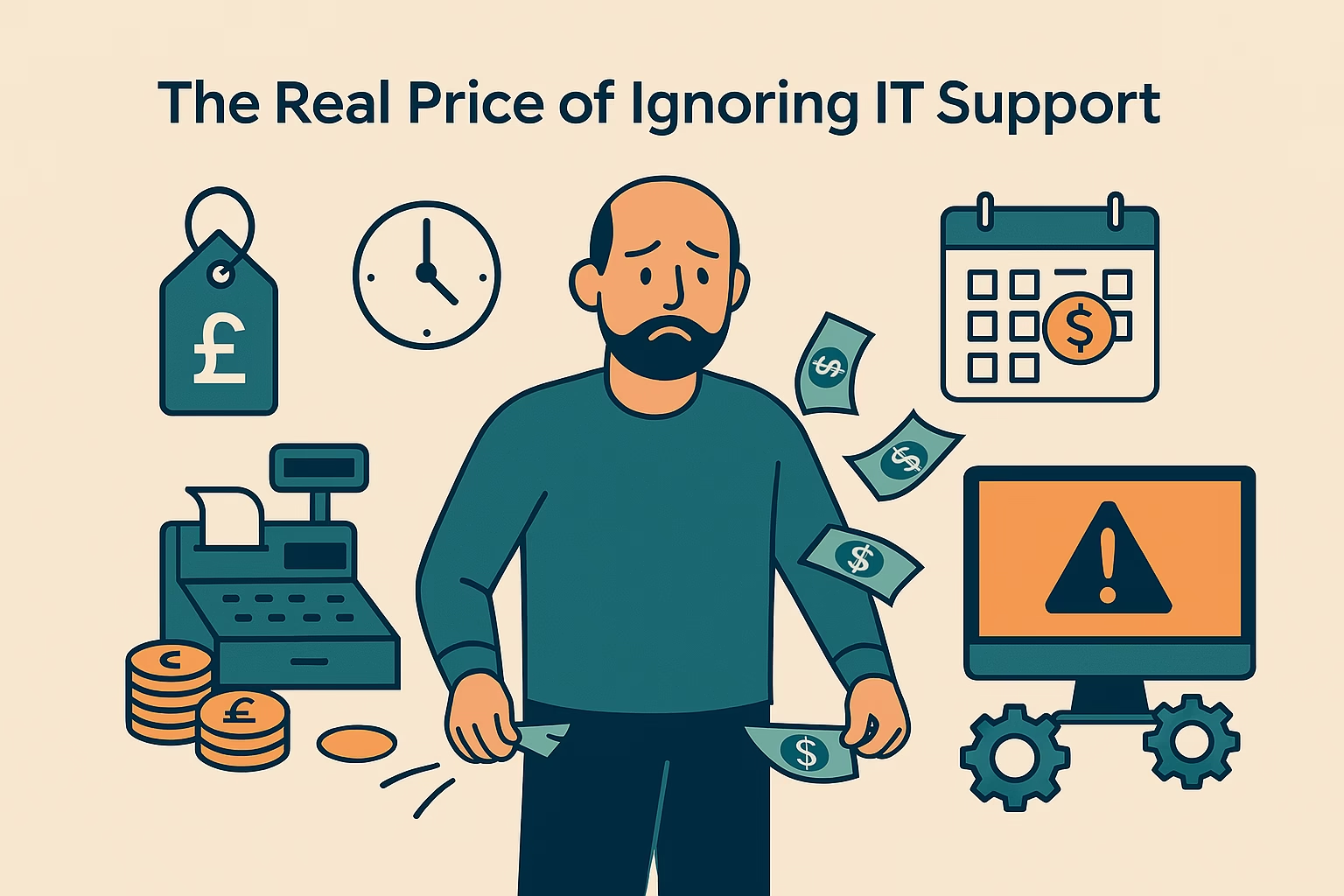
The Real Price of Ignoring IT support London
When IT support is neglected, the costs stack up quickly:
- Unplanned downtime: Lost sales, missed appointments, stalled production, and poor customer experiences.
- Security incidents: Ransomware, phishing, and account compromise that halt operations or expose sensitive data.
- Shadow IT & tech debt: Unapproved tools and outdated systems that create security gaps and inefficiency.
- Compliance exposure: Fines and legal risk when controls don’t meet GDPR or sector requirements.
- Productivity loss: Staff fighting tech fires instead of serving customers, patients, or clients.
A proactive IT support model reduces incidents, shortens mean time to resolution, and standardises your environment so issues don’t domino into costly outages.
How Neglect Impacts Different Industries
Different sectors face distinct risks, and tailored IT support reduces them:
- Hospitality IT support London: Venue management systems, workflows, if they fail, production halts and compliance risk rises.
- Retail IT support London: POS outages, payment failures, and stock inaccuracies mean immediate revenue loss and chargebacks.
- Manufacturing IT support London: Production line downtime, OT/IT integration risks, and ransomware on controllers can stop output.
- Construction IT support London: Site connectivity, shared drawings, BIM, and subcontractor access need secure, reliable infrastructure.
- Legal IT support London: Case management, secure client portals, and email security are critical to confidentiality and SRA expectations.
- Accountancy IT support London: Secure handling of payroll, tax data, and client files with strict access controls and audit trails.
- Startups IT support London: Speed without sprawl — secure-by-design setups to avoid costly rework and compliance surprises.
- Estate Agency IT support London: CRM uptime, secure tenancy data, anti-phishing email controls, and remote work stability.
- Marketing Agency IT support London: Asset libraries, collaboration tools, large file workflows, and client data safeguards.
- Logistics & Transport IT support London: Fleet tracking, WMS/TMS uptime, ePOD systems, and 24/7 operational resilience.
- Hospitality & Leisure IT support London: Booking engines, Wi‑Fi networks, POS, and guest data privacy.
- Architects IT support London: CAD/BIM performance, version control, secure sharing, and IP protection.
- Boutique Hotels IT support London: PMS, guest Wi‑Fi segmentation, payment security, and always-on front-of-house.
- Pharmacies IT support London: Dispensing systems, eRx, and data integrity — failure directly impacts patient safety.
The Cybersecurity Risks You Can’t Afford to Ignore
With cyber threats evolving faster than ever, businesses can no longer afford to take a reactive approach to security.
Phishing attacks, ransomware, credential theft, and supply–chain vulnerabilities pose serious financial, operational, and reputational risks, often striking without warning.
What are the Cyber Security Risks in 2026 For Small Business?
- Phishing and Business Email Compromise (BEC): Targets finance and leadership to divert payments or steal credentials.
- Ransomware: Encrypts systems, halts operations; recovery hinges on solid backups and network segmentation.
- Credential stuffing & MFA fatigue: Weak or reused passwords and poor MFA policies increase breach risk.
- Supply chain attacks: Vulnerable plugins, integrations, and third-party vendors become an entry point.
- Shadow IT: Unvetted tools create data leakage and compliance gaps.
A layered IT support approach with endpoint protection, DNS filtering, email security, identity and access management, SIEM/SOC monitoring, and user awareness training is now table stakes.
Compliance Isn’t Optional: GDPR, HIPAA & Sector Standards
Cybersecurity compliance isn’t just paperwork, it shapes the technical controls you must implement:
- GDPR (UK/EU): Lawful processing, data minimisation, encryption, access controls, breach notification, and DPIAs for high‑risk processing.
- HIPAA (where applicable): For practices handling patient data with US-related obligations, requires administrative, physical, and technical safeguards.
- Sector guidance: For legal (SRA), financial (FCA/ISO 27001 alignment), healthcare (NHS DSP Toolkit), and payments (PCI DSS).
Practical compliance measures within IT support include endpoint encryption, centralised identity, privileged access management, logging and monitoring, vendor management, data retention policies, and documented incident response.
Disaster Recovery: Backups, Business Continuity, and Confidence
Downtime is expensive. A robust disaster recovery (DR) strategy should include:
- Automated, immutable backups with offsite copies and tested restores (3‑2‑1 rule: three copies, two media, one offsite).
- RPO/RTO targets aligned to the business impact (how much data you can lose; how fast you must recover).
- Application‑aware backups for databases, PMS/ERP/CRM, and line-of-business systems.
- Runbook playbooks for power failure, cyber incidents, and site loss.
- Regular DR tests reported to leadership.
For clinics, pharmacies, and professional services, this ensures no patient or client data is lost during power or system failures, and you can prove it to auditors.
Mobile Device Management (MDM): Securing Work on the Move
Staff increasingly work from sites, client offices, or on the road. MDM underpins secure mobility:
- Device enrolment & posture checks (OS version, encryption, PIN/biometric).
- App whitelisting and containerisation for corporate data separation.
- Remote wipe for lost/stolen devices.
- Conditional access: Only compliant devices access email, files, and apps.
- Location and usage policies suited to healthcare home visits, construction sites, and logistics fleets.
Why WatchGuard + a Managed Security Service Provider (MSSP) Is a Smart Bet
Pairing WatchGuard security with a capable Managed Security Service Provider gives you enterprise-grade protection without enterprise overhead:
WatchGuard Coverage Examples
- Firebox Firewalls: UTM/NGFW, IPS, gateway AV, application control, and SD‑WAN with zero‑touch deployment.
- DNSWatch: DNS filtering that blocks malicious domains and provides user coaching post-click.
- AuthPoint MFA: Cloud MFA, risk-based policies, and secure SSO critical for phishing and BEC defence.
- Endpoint Protection, Detection & Response (EPDR): AI-driven prevention with managed threat hunting.
- Secure Wi‑Fi: WIPS to detect and block rogue APs, guest segregation for hospitality and hotels.
MSSP Advantages
- 24/7 monitoring & incident response via SOC analysts.
- Policy tuning and proactive threat hunting.
- Compliance reporting mapped to GDPR/ISO controls.
- Patch & vulnerability management across servers, endpoints, and network devices.
- Cost predictability with a per-user/per-site model that scales across multi-location retail, hospitality, and logistics.
Calculating the ROI of Proactive IT support London
A realistic ROI model for IT support includes:
- Downtime avoided × average hourly revenue/operational cost.
- Breach probability reduction × expected loss (ransom, legal, PR, downtime).
- Productivity gains from standardised devices, SSO, and fast support SLAs.
- Audit & compliance savings: fewer fines, faster due diligence with partners/insurers.
- Asset lifecycle optimisation: extend useful life without sacrificing performance or security.
Most SMEs find that the annual cost of managed IT support is significantly lower than a single major incident.
Action Plan: How to Close Your IT Gaps This Quarter
- Baseline audit: Security posture, patch status, identity controls, backup health, and vendor risk.
- Prioritise quick wins: MFA everywhere, DNS filtering, email security, admin account lock‑down, and automated backups.
- Harden endpoints and access: EDR, least privilege, conditional access, and device encryption.
- Network segmentation: Separate guest Wi‑Fi, OT/IoT, and critical systems (vital for hospitality, manufacturing, pharmacies).
- Implement MDM for mobiles, tablets, and field devices.
- Select an MSSP with WatchGuard for 24/7 coverage, SIEM/SOC, and compliance reporting.
- Test DR and document incident response.
- Train users quarterly on phishing, data handling, and password hygiene.
By partnering with Speedster IT, organisations gain a dependable, security‑focused provider that prioritises stability, compliance, and long‑term resilience.
With proven expertise across diverse sectors and a proactive approach to monitoring, support, and incident prevention, Speedster IT helps businesses minimise risk, reduce downtime, and maintain seamless operations.
Companies that choose Speedster IT benefit from tailored solutions, rapid response times, and the reassurance that their technology is being managed by a team committed to protecting performance, reputation, and growth.
With over 15 years at Speedster IT, I’ve built a career around helping businesses navigate the evolving world of technology. I publish all the content for the IT Support London Blog and Cyber Security Blog, where I share practical insights on infrastructure upgrades, cybersecurity trends, and smart IT strategies for growing companies.